Welcome to DisneyBizJournal.com - News, Analysis and Reviews of the Disney Entertainment Business!

Brought to fans, investors, entrepreneurs, executives, teachers, professors, and students by columnist, economist, novelist, reviewer, podcaster, business reporter and speaker Ray Keating

Showing posts with label economics. Show all posts

Wednesday, April 20, 2022

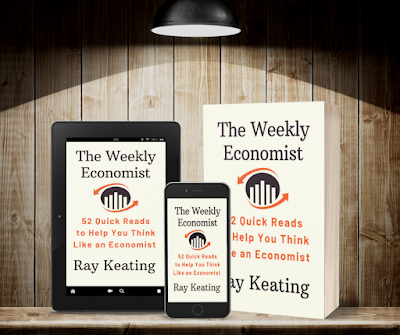
NEW BOOK: “The Weekly Economist” by DisneyBizJournal’s Ray Keating Helps Readers to Think More Like an Economist

 Ray Keating’s New Book Offers Quick Reads on Wide-Ranging Topics and Questions Related to the Economy and Business


If you don’t have a degree in economics, how do you figure out what actually makes economic sense and what doesn’t? Ray Keating, a leading economist on small business and entrepreneurship, offers help with a new book titled The Weekly Economist: 52 Quick Reads to Help You Think Like an Economist.


Whether via CNBC, CNN, FOX, websites, or other outlets, many assertions regarding the economy and economic policy are presented that leave people wondering what’s accurate and what’s not. That’s especially the case when declarations by one talking head are conflicted by the next one. The Weekly Economist offers quick reads on topics essential to thinking clearly on economics, or applying sound economic principles to hot topics.


Ray Keating notes, “Yes, economics and thinking more like an economist matter. It is my hope that individuals, by taking just a few minutes for a quick read each week, can clarify their thinking on economics, and thereby, improve their own lives, and the lives of family, friends, colleagues, neighbors, as well as people across the nation and around the world."


Beyond a general readership interested in the economy, The Weekly Economist is ideal for the classroom, boardroom and workplace.


The Weekly Economist complements Ray Keating’s Free Trade Rocks: 10 Points on International Trade Everyone Should Know, which is an excellent economics introduction to the often controversial topic of free trade.


Paperbacks, hardcovers and the Kindle edition of The Weekly Economist are available at Amazon.com, and signed books at www.RayKeatingOnline.com


Review copies, and author interviews and appearances are available upon request. 


Praise for Ray Keating’s work…


“Keating is at his best when tackling the issue that introduced him to the world of conservative thought: the benefits of the free market.”  - Kirkus Reviews


“Keating is no sour-puss conservative... Keating’s pro-growth agenda of dramatic supply-side tax and regulatory cuts, school choice, and much smaller government stands as New York’s only chance at rebirth.”  - Steve Forbes


Ray Keating's "take on the economy is unabashedly supply-side, offering a clear understanding that risk taking and entrepreneurship are the engines of economic growth.” - Jack Kemp


“Keating manages to bring this seemingly dull subject to accessible life with real-world examples often torn straight from recent headlines, along with a comprehensive and (mostly) impartial view on the topic.” – Self-Publishing Review on Free Trade Rocks!


“A common-sense explanation of why politicians and bureaucrats shouldn't throw sand in the gears of global trade.” - Dan Mitchell, Chairman, Center for Freedom and Prosperity, on Free Trade Rocks!

Saturday, March 26, 2022

Pre-Order the New Book by Disney Biz Journal's Ray Keating

 Pre-Order Ray Keating’s New Book Today – The Weekly Economist: 52 Quick Reads to Help You Think Like an Economist – Signed by the Author – Pre-Order Here! Go to https://raykeatingonline.com/products/weeklyeconomist


If you don’t have a degree in economics, how do you figure out what actually makes economic sense and what doesn’t? Ray Keating, a leading economist on small business and entrepreneurship, offers help with a new book titled The Weekly Economist: 52 Quick Reads to Help You Think Like an Economist.


Whether via CNBC, CNN, FOX, websites, or other outlets, many assertions regarding the economy and economic policy are presented that leave people wondering what’s accurate and what’s not. That’s especially the case when declarations by one talking head are conflicted by the next one. The Weekly Economist offers quick reads on topics essential to thinking clearly on economics, or apply sound economic principles to hot topics.


Ray Keating writes, “Yes, economics and thinking more like an economist matter. It is my hope that individuals, by taking just a few minutes for a quick read each week, can clarify their thinking on economics, and thereby, improve their own lives, and the lives of family, friends, colleagues, neighbors, as well as people across the nation and around the world."


Praise for Ray Keating’s work…


“Keating is at his best when tackling the issue that introduced him to the world of conservative thought: the benefits of the free market.”  - Kirkus Reviews


“Keating is no sour-puss conservative... Keating’s pro-growth agenda of dramatic supply-side tax and regulatory cuts, school choice, and much smaller government stands as New York’s only chance at rebirth.”  - Steve Forbes


Ray Keating's "take on the economy is unabashedly supply-side, offering a clear understanding that risk taking and entrepreneurship are the engines of economic growth.” - Jack Kemp


Sunday, June 7, 2020

Disney and the Economy: Uncertainty and a Call for Walt’s Realistic Optimism

by Ray Keating
Analysis
DisneyBizJournal.com
June 7, 2020

The current economy serves up another call for Walt Disney’s realistic optimism – at least, over the longer haul.

My favorite quote from Walt (as I’ve written before) is: “I always like to look on the optimistic side of life, but I am realistic enough to know that life is a complex matter.” Indeed, while many people emphasize Walt as a dreamer – which he was – when you look at what he accomplished in life, Walt Disney was a realistic optimist. 


I try to be the same way. Some might scratch their heads, but it was a realistic optimism that led me to becoming an economist. How does that work – isn’t economics the dismal science? Actually, no (see my Free Enterprise in Three Minutes Podcast episode titled “Economics? Not Dismal, But Rather Exciting.”) To sum up very quickly, seeing the astounding results of the free enterprise system (in terms of wealth creation, income and job growth, alleviation of poverty, improved quality of life, and so on) should fuel optimism. Walt Disney, again, shared optimism in this area, as he once expressed in talking about his plans for Walt Disney World: “But if we can bring together the technical know-how of American industry and the creative imagination of the Disney organization – I’m confident we can create right here in Disney World a showcase to the world of the American free enterprise system.”

Meanwhile understanding how free enterprise works provides grounding in realism, given, for example, wrongheaded governmental policies that can undercut free enterprise. Of course, a pandemic combined with governmental decisions to shut down large parts of our economy to try to limit the spread of and deaths related to COVID-19 makes for a recipe meant to uncut free-enterprise optimism.

Few have been immune from the negative economic fallout. Indeed, it has been breathtaking. And The Walt Disney Company, and its shareholders, employees and customers certainly have been hit.

Consider, for example, that Disney’s stock price had reached a high of $151.64 on November 26, 2019, and then it traveled on a relatively slow downward path to $140.37 on February 19, 2020. But then the COVID-19 news fully walloped Disney and the market in general. By March 20, the Disney stock price had fallen to $85.76. Uncertainty became the rule of the day in terms of the coronavirus, its health and economic impact, and the governmental policies imposed in response. 

But since that March 20 recent low, Disney’s share price has risen, closing at $124.82 on Friday, June 5. Investors started to gain more information, and begin the process of looking beyond the immediate crisis.

On Disney specifics, back on March 18 (“Don’t Expect Disney Parks To Open Anytime Soon”), DisneyBizJournal.com noted that the economy already was in recession, and answered the unmoored optimists by pointing out that expecting Disney to reopen their domestic parks before “mid-May or even June” was, well, unrealistic. And on May 27, Disney announced the start of phased reopenings for Magic Kingdom and Animal Kingdom starting on July 11, and EPCOT and Hollywood Studios on July 15. And we still have no word from Disney on a reopening date for Disneyland in California.

Just like other businesses, Disney has been dealing with the two overarching factors that still contain significant degrees of uncertainty – the coronavirus and the state of the economy.

On the COVID-19 front, for example, the John Hopkins Coronavirus Resource Center reported on June 7 that total coronavirus deaths in the U.S. have hit 110,037. Additionally, coronavirus cases are on the rise in Florida. Yesterday (June 6), TCPalm.com reported:

“There were 1,270 new cases of COVID-19 announced by the Florida Department of Health Saturday morning, the fourth day of four-digit increases. Thursday's report of 1,419 new cases was the largest single-day increase of confirmed COVID-19 cases since the pandemic began. There are now 62,758 confirmed COVID-19 cases in the state. The number of reported deaths increased to 2,688, an increase of 28 since Friday.”

As for the economy, the news, as expected, has been grim, according to a variety of government reports over the past week or so. For example, trade from February to April plunged, with U.S. exports down by 28.6 percent and imports by 18.6 percent. Over the same period, U.S. wages and salaries declined by 12.7 percent, and proprietors’ income (i.e., small business sole proprietors and partnerships) plummeted by 19.5 percent. During the first quarter of this year, real GDP (gross domestic product) plunged by 5 percent – the second largest decline over the past 38 years. 

For good measure, while assorted people – including market investors – were excited about the employment report for May (released on Friday, June 5) showing a gain of 2.5 million to 3.8 million jobs, that must be put in context of having lost more than 25 million jobs from February to April. In addition, the May data are subject to classification errors, and therefore, the unemployment rate actually was “about 3 percentage points higher than reported,” according to the U.S. Bureau of Labor Statistics. That’s roughly an additional 4.7 million unemployed people, on top of the 21 million reported for May.

The question remains: When will the recovery start, and what will it look like? Little reason exists to bet on the U.S. economy quickly getting back to where it was before – a so-called V-shaped recovery – and then getting about the business of expansion. However, barring a reacceleration in pandemic challenges and anti-growth economic policymaking (arguably the biggest threat down the road), the U.S. economy will get back on a growth path, eventually climbing back to where we were in terms of jobs and output prior to the pandemic, and then moving beyond. It’s not a question of “if,” but it’s definitely a question of “when.”

For Disney, therefore, uncertainty will persist across most of its portfolio of businesses, including theme parks, hotels and restaurants; movies; and cruise lines. So, yes, there remains a reason why the Disney stock price, while recovering some recently, still has not returned to where it was in late November.

Once again, we need to consider Walt Disney’s quote – “I always like to look on the optimistic side of life, but I am realistic enough to know that life is a complex matter.” It’s as if Walt is reaching out from the past to give us some sage advice for today. 

__________

See related...


See recent...


See notable...

__________

Ray Keating is the editor, publisher and economist for DisneyBizJournal.com, and author of The Disney Planner 2020: The TO DO List Solution (now available at a deep discount) and the Pastor Stephen Grant novels. He can be contacted at  raykeating@keatingreports.com.

Get the paperback or Kindle edition of Ray Keating’s new book Behind Enemy Lines: Conservative Communiques from Left-Wing New York.

Thursday, September 19, 2019

FREE TRADE ROCKS! Explains What Everyone Should Know about International Trade

Ray Keating Explores How Free Trade Benefits People Throughout the Nation, Around the World and Across Income Levels 

Long Island, NY –While free trade has come under attack, Ray Keating lays out in clear, simple fashion the benefits of free trade and the ills of protectionism in FREE TRADE ROCKS! 10 POINTS ON INTERNATIONAL TRADE EVERYONE SHOULD KNOW.


Tapping into his experiences as an economist, policy analyst, newspaper and online columnist, entrepreneur, and college professor, who taught MBA courses on international business and entrepreneurship, Keating explores and explains in straightforward fashion 10 key points or areas that everyone - from entrepreneurs and executives to students and employees to politicians and taxpayers - needs to understand about how trade works and how free trade generates benefits for people across towns, the nation and international borders.

The 10 points or areas covered in FREE TRADE ROCKS! are...

Point 1: Do People "Get It" on Free Trade?

Point 2: Economics 101 on Trade

Point 3: Debunking Trade Myths

Point 4: Trade and the U.S. Economy

Point 5: Trading Partners

Point 6: Trade and Small Business

Point 7: Ills of Protectionism

Point 8: Brief History of Free Trade Deals

Point 9: The Morality of Free Trade

Point 10: The Future of Trade

Keating makes clear that nations don't trade. Instead, businesses and individuals trade, and free trade is simply about expanding the freedom to trade by reducing or eliminating governmental costs and restrictions.

Regarding FREE TRADE ROCKS!, Dan Mitchell, Chairman of the Center for Freedom and Prosperity, declares, “A common-sense explanation of why politicians and bureaucrats shouldn't throw sand in the gears of global trade.”

And Self-Publishing Review gives FREE TRADE ROCKS! four stars, and says: “International trade policy has come to the forefront of global politics, making FREE TRADE ROCKS! 10 POINTS ON INTERNATIONAL TRADE EVERYONE SHOULD KNOW by Ray Keating a timely and fascinating read for a suddenly curious demographic. Keating manages to bring this seemingly dull subject to accessible life with real-world examples often torn straight from recent headlines, along with a comprehensive and (mostly) impartial view on the topic. As the exclamatory title suggests, Keating is a fan of free trade, but his deep expertise spanning a wide range of subjects and career paths makes this book an engaging, informative, and essential read for those who want to weigh in on this hot-button issue."

Also, George Leef, the Director of Research at the James G. Martin Center for Academic Renewal, observes, “Ever since Donald Trump started talking about foreign trade, I have thought that what the country needs is a clear, easily understood book that explains why the government should not mess with free trade. Lo and behold, Ray Keating has written exactly that book. FREE TRADE ROCKS!clears away the myths and misconceptions that trade interventionists count on.”

Beyond a general readership interested in our economy, FREE TRADE ROCKS! is ideal for the classroom, boardroom and workplace.

Paperbacks and Kindle edition available at Amazon.com.

Review copies, and author interviews and appearances are available upon request. 

Contact: Ray Keating
Phone: 631-909-1122
Twitter: @FreeEnterprise7
FreeEnterpriseEconomics.com
RayKeatingOnline.com

Wednesday, April 24, 2019

6 Economics Lessons for Abigail Disney

by Ray Keating
Commentary
DisneyBizJournal.com
April 24, 2019

Abigail Disney, a filmmaker and the grandniece of Walt Disney, is very upset about executive pay at the Walt Disney Company. She made this clear in a Washington Post op-ed. Unfortunately, she also made it clear that she understands nothing about economics and how earnings are determined. 

Ms. Disney complained about “the naked indecency of chief executive Robert Iger’s pay.” Golly. She then went on to compare executive pay to the average worker’s, railed against tax cuts, and attacked the Disney company for opposing a minimum wage hike in the city of Anaheim. I hate to say it: This reads like a typical left-wing, Hollywood diatribe devoid of any economic sense, and the only reason that Ms. Disney is getting attention is because of her last name.


Now, let’s try to help Ms. Disney, and others, understand some basic economics when it comes to compensation. I do a regular podcast titled “Free Enterprise in Three Minutes,” and have dealt with the economics of earnings and wages in several episodes.

I’m currently doing a series on “What People Earn.” So, there’s three minutes (give or take) for each of the following:

Episode 31: What People Earn, Part I: Productivity explains that, ultimately, earnings, or incomes, are determined by productivity, that is, output per worker.

Episode 32: What People Earn, Part II: Boosting Productivity notes, “Higher earnings for workers are not about government mandating a minimum wage or a living wage. Instead, higher earnings are about increasing output, value or productivity in a competitive market.”

Episode 33: What People Earn, Part III: Why Does Mike Trout Earn More than Teachers? tackles the issue of someone like Angels outfielder Mike Trout earning more than your average school teacher – again, based on economics rather than how someone might feel.

And the latest episode deals directly with Ms. Disney’s complaint. It is titled Episode 34: What People Earn, Part IV: Why CEOs Make Far More Than Their Employees, and I explain the basics on why CEOs of businesses make so much more than those on the assembly line, covering the sales floor, or driving the trucks.

There are other episodes that Ms. Disney could benefit from in terms of understanding the actual economics at work, such as Episode 21: The Ills of Price Controls, which explains, in part, why a minimum wage hurts, rather than helps, young, inexperienced, low-skill workers, and Episode 15: Marx Was Wrong – Owners and Labor Work Together, which lays out how the real relationship between business owners and workers functions, as opposed to the idea that one is pitted against the other.

So, there you have it. Six quick lessons for Ms. Disney and others on the economics of earnings. That’s a total of about 18 minutes in listening time. Now, how many people who line up with Ms. Disney on such matters will carve out this little bit of time to gain a better grasp on economics and compensation? I’m guessing not many – and that is unfortunate.

Ray Keating is the editor, publisher and economist for DisneyBizJournal.com, and author of the Pastor Stephen Grant novels, with three books - Reagan Country: A Pastor Stephen Grant NovelHeroes and Villains: A Pastor Stephen Grant Short Story and Shifting Sands: A Pastor Stephen Grant Short Story – published in 2018. In addition, the second edition of Warrior Monk: A Pastor Stephen Grant Novel was published in January 2019. He can be contacted at  raykeating@keatingreports.com.