Welcome to DisneyBizJournal.com - News, Analysis and Reviews of the Disney Entertainment Business!

Brought to fans, investors, entrepreneurs, executives, teachers, professors, and students by columnist, economist, novelist, reviewer, podcaster, business reporter and speaker Ray Keating

Showing posts with label Florida. Show all posts

Wednesday, April 27, 2022

6 Big Reasons Why the DeSantis Attack on Disney is a Disturbing and Costly Political Mess

 by Ray Keating

Commentary/Analysis

DisneyBizJournal.com

April 27, 2022


Hold on a minute. I’m confused. I thought Republicans were against debt relief. For good measure, I was under the impression that Florida Governor Ron DeSantis, a Republican, was less than thrilled with the Walt Disney Company.


But if that’s all true, then why have DeSantis and Florida Republican state legislators at least opened the door to massive debt relief for Disney, as well as a possible big tax cut for the House of Mouse? Hmmm, does this mean that DeSantis secretly loves Disney?


Well, let’s not get carried away. 


In reality, what DeSantis has done is lash out at the Walt Disney Company in the hopes of stirring up and ingratiating himself with parts of the Republican Party base. However, being governor of the third largest state in the nation means – or should mean – that you don’t irresponsibly treat businesses, residents and the Florida economy as your personal political playthings. But then again, DeSantis is trying to position himself as the next Donald Trump, so…


As a quick reminder, DeSantis and Disney disagreed on Florida’s House Bill 1557. And yes, it was incredibly dumb for Disney to stake out ground on this issue when it has nothing to do with its business. But Disney CEO Bob Chapek caved to some vocal activists in his company, and the result has been a mess for the company. (See DisneyBizJournal’s previous analyses on this herehere and here.) 


However, even if one disagrees with Disney’s decision on this – which I strongly do, by the way – that doesn’t in turn mean that one should support the charge led by DeSantis to use legislation to punish a company that he disagrees with on an issue. Nonetheless, that’s exactly what DeSantis along with Republicans in the Florida state legislature did when passing legislation that will dissolve Walt Disney World’s Reedy Creek Improvement District as of June 1, 2023.


Reedy Creek was created in 1967 and allowed Disney to effectively self-govern the 25,000 acres the company purchased to create Walt Disney World. That means that Disney, through the District, controls essential services like infrastructure, electricity, water, sewage, zoning, solid waste and recycling, building codes and approvals, and a fire department. It’s a unique set up pertaining to a unique situation. Reedy Creek covers two towns, Bay Lake and Lake Buena Vista, with about 50 residents today who own the land and actually elect their own mayors and city councils. These residents obviously are Disney employees.


So, let’s review the rather lengthy list of problems with this egregious act by DeSantis and GOP state legislators.


First, government punishing a company for the stance it takes on a political issue flies directly in the face of the First Amendment. You know: “Congress shall make no law … abridging the freedom of speech…” Indeed, this act is a deeply disturbing act by government that should outrage everyone, including all of those Republicans who used to talk about how much they loved freedom and abhorred big, abusive government.


Second, the U.S. Constitution also prohibits bills of attainder (Article I, Section 9, Clause 3). That is, legislative acts cannot be used to punish a particular individual or entity. As explained in the case United States v. Lovett, legislative acts are prohibited that “no matter what their form … apply either to named individuals or to easily ascertainable members of a group in such a way as to inflict punishment on them without a judicial trial…” Again, I remember when Republicans at least spoke about the need for separation of powers. Of course, the response is that this bill covers a few other districts created before 1968 as well. That, of course, is a farce, as the intent has been made clear by the governor and state lawmakers that this legislation is meant to punish Disney.


Third, contracts matter, but the law dissolving the Reedy Creek District ignores the binding contract that the state has with holders of Reedy Creek bonds. As explained in an analysis at Bloomberg Law:


In authorizing Reedy Creek to issue bonds, the Florida legislature included a remarkable statement—included in Reedy Creek’s bond offerings—regarding its own promise to bondholders: “The State of Florida pledges to the holders of any bonds issued under this Act that it will not limit or alter the rights of the District to own, acquire, construct, reconstruct, improve, maintain, operate or furnish the projects or to levy and collect the taxes, assessments, rentals, rates, fees, tolls, fares and other charges provided for herein … until all such bonds together with interest thereon, and all costs and expenses in connection with any action or proceeding by or on behalf of such holders, are fully met and discharged.”


As noted later in the Bloomberg piece:


By dissolving Reedy Creek, the legislature essentially rewrote the promises made in the district’s bond offerings. Instead of bonds backed by a special district with the power to levy up to 30 mills in taxes, the property tax bonds will be backed jointly by two governments that can only generate a maximum of 10 mills in taxes. Instead of a unified utility system with special powers to charge various fees, supported by special taxing powers, utility revenue bonds will be jointly managed by two counties subject to additional taxing and spending restrictions.

      Both the U.S. and Florida constitutions place strict limitations on the government’s ability to impair its own contracts. Under the U.S. Constitution, a state can only impair an existing contract if the impairment is reasonable and necessary to serve an important government purpose. As early as 1866, the U.S. Supreme Court held that once a local government issues a bond based on an authorized taxing power, the state is contract-bound and cannot eliminate the taxing power supporting the bond. The Florida Constitution provides even greater protection from impairment of contracts.


Fourth, this bondholder language points to a host of problems regarding bonds and taxes. As the Bloomberg piece, as well as other analyses, points out, “The bill dissolving Reedy Creek doesn’t say what should happen to these debts, but another statute does: By default, the local general-purpose government—the county—assumes the district’s debt, along with all of its assets. This means that theoretically, Orange and Osceola counties will inherit upward of $1 billion in bond debt.” Other reports put the amount of Reedy Creek debt higher.


Indeed, among the unknowns is the distinct possibility of hitting taxpayers in two local counties with big tax increases. 


Disney already pays both sales and property taxes to localities, such as counties and school districts. In fact, CNBC reported, “Public records show Disney is the largest taxpayer in central Florida, paying over $280 million in property taxes to the counties between 2015 and 2020.” Also, as noted, Disney effectively pays taxes to itself with the Reedy Creek District, with Reedy Creek collecting $164 million annually from Disney to pay for services like road maintenance, utilities, fire protection, and so on.


GOP state lawmakers claim that Reedy Creek taxes will get shifted to the counties. But Disney taxes itself at a much higher property tax rate than is allowed by the state constitution. In fact, three times higher, as noted above. So, if Reedy Creek were dissolved, a massive amount of costs would be shifted to the counties, but Disney would pay less than it is now in taxes. CNBC noted:


Tax experts say that in order for the counties to collect additional revenue from Disney to pay the bond debt, the counties would have to create a new special tax district of their own. Even if they created a new special “Disney” tax district, the tax rate would be capped below that of the current district rate, leaving Orange and Osceola counties with Reedy Creek’s debt service but with less revenue to pay it off.


For good measure, government has little ability to control costs, so the bill to local taxpayers promises to be rather substantial, though, again, no formal analysis has been done at this point.


Plus, if the dissolving of Reedy Creek goes this route, bondholders no doubt will sue, and that will prove to be a costly legal battle paid for by taxpayers in service of Governor DeSantis’ political desires.


Hmmm, remember when the top issue for Republicans was tax relief?



Fifth, the legislation was created in haphazard fashion, to say the least. At the last minute, it was crammed into a special session. Legislators got to look at the bill for two days before it was rammed through without any substantive analysis as to the effects of the legislation, such as on taxpayers and the economy, nor does it spell out how the dissolution would actually work. Indeed, no one seems to have a clue as to how any of this would work. DeSantis and legislators promise to get around to that down the road. According to the Orlando Sentinel, “Not even the bill’s sponsors – Sen. Jennifer Bradley, R-Fleming Island, and Rep. Randy Fine, R-Palm Bay – could provide the intricate details of how Reedy Creek would be dissolved, saying the matter will be hammered out in the next year.” Sure, right, let’s not spoil this political opportunity to pander with potentially messy details. So much for slowing the mechanism of government to consider the full implications.


Sixth, there’s also the fact that state law requires a voter referendum by residents or land owners in a special district in order to dissolve that district. Obviously, Disney isn’t going to vote for that. But according to the Sentinel, Republican lawmakers claim that the new law trumps the old law. That is in dispute, and would lead to another costly legal battle.


Of course, the key benefit that the Reedy Creek District offers Disney is to avoid costly meddling and delays that come with being regulated by local governments. Walt Disney experienced those problems firsthand in California, and sought to avoid such an outcome in Florida. And if the Reedy Creek district actually is dissolved, Disney not only will face costly regulations that create delays and raise costs, but also local governments running various services that Disney has been doing. Disney has operated such services efficiently, you know, like a business does if it wants to succeed. When was the last time you hit a pothole in Disney World? Turning such operations over to government would mean diminished quality of service, as government is wont to do, along with increased dollar costs.


One might think that Republicans, who used to care about the economy, would be trying to figure out how they can expand the opportunity for more businesses to be able to do what Disney has in terms of more efficiently running various services, rather than punishing the company who has shown that, yes, business can do most things better than government. And again, with Disney doing the work and paying for it, taxpayers don’t get hit with the bill.


Geez, it’s almost like Governor DeSantis and his fellow Republicans in the state legislature didn’t really think this through, or they didn’t really care to think about anything other than political pandering. Go figure.


As for Disney, company corporate affairs officer Geoff Morrell was quoted by the Hollywood Reporter back on March 2, 2022, saying: 


“Whatever Bob’s personal politics are, he’s not an activist and does not bring any partisan agenda to work. He sees himself first and foremost as the custodian of a unifying brand that for nearly a century has been bringing people together, and he is determined that Disney remain a place where everyone is treated with dignity and respect… He believes the best way we can help create a more inclusive world is through the inspiring content we produce, the welcoming culture we create and the diverse community organizations we support.” 


That’s spot on correct. Chapek and Disney (and its shareholders) would have fared much better in this situation and would be better positioned going forward when other hot-button topics inevitably crop up with activists trying to pressure the company, if they had stuck with what Morrell explained. But Chapek caved, and the company has been dragged into the muck of politics in an era when the hard Left and populist Right thrive on division and controversy.


__________


Ray Keating is the editor, publisher and economist for DisneyBizJournal.com, and author of the Pastor Stephen Grant novels and assorted nonfiction books. Have Ray Keating speak your group, business, school, church, or organization. Email him at raykeating@keatingreports.com.


The views expressed here are his own – after all, no one else should be held responsible for this stuff, right?


Two great ways to pre-order Cathedral: An Alliance of Saint Michael Novel, which is Ray’s sixteenth work of fiction, and the first in the Alliance of Saint Michael series. Signed paperbacks here and the Kindle edition here


Two great ways to order Ray Keating’s new nonfiction book – The Weekly Economist: 52 Quick Reads to Help You Think Like an Economist. Signed paperbacks here, and paperbacks, hardcovers and Kindle editions here.  


Get all of Ray Keating Pastor Stephen Grant thrillers and mysteries in paperback and for the Kindle at Amazon.com and signed books at www.RayKeatingOnline.com


Get more out of the rest of 2022 with The Disney Planner 2022: The TO DO List Solution! It combines a simple, powerful system for getting things done with encouragement and fun for Disney fans, including those who love Mickey, Marvel, Star Wars, Indiana Jones, Pixar, princesses and more. Also, “The Disney Planner 2022: The TO DO List Solution” comes with a handy spiral binding for easy use. It’s on sale and shipping is always free!


Also, check out Ray’s podcasts – the Daily Dose of DisneyFree Enterprise in Three Minutes, and the PRESS CLUB C Podcast.

Sunday, April 3, 2022

Some Conservative Disney Employees Ask: What About Us?

 by Ray Keating

News/Commentary

DisneyBizJournal.com

April 3, 2022


A corporation getting involved in hot political topics rarely turns out to be a wise choice. Disney executives seem to be getting a lesson on this front recently. 


Disney seemed to succumb to pressure from left-wing political activists, including some Disney employees, to weigh in heavily against a piece of legislation in Florida. (That is, the Parental Rights in Education Act, or misleadingly labeled by activists in opposition as the “don’t say gay” bill.) However, leftist groups don’t seem all that pleased with Disney’s tardiness to the issue, while lawmakers in Florida are threatening to turn against one of its top businesses and employers, and people on the Right grumble at the House of Mouse. 


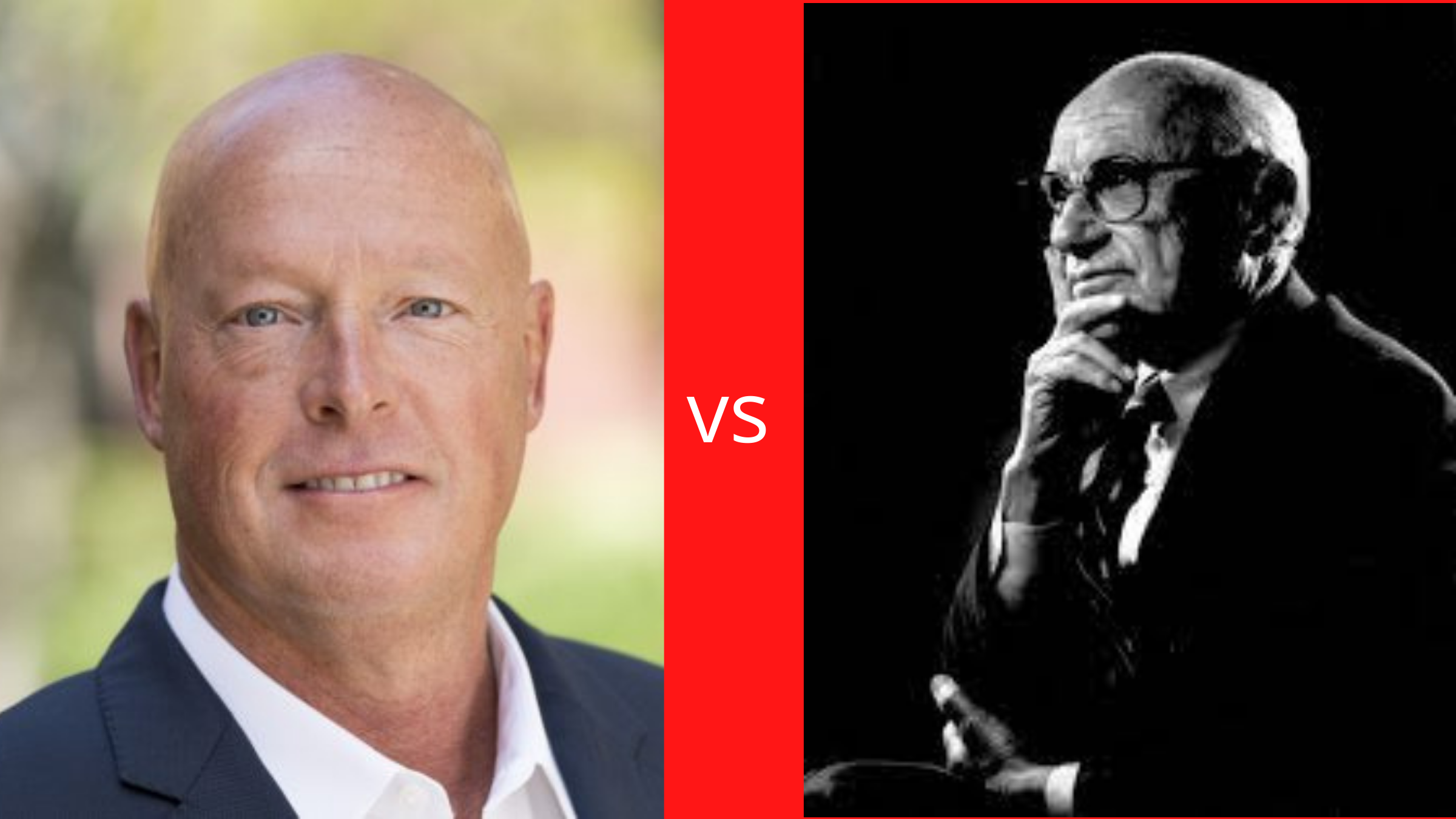
In a recent DisneyBizJournal article, I raised questions from an economist perspective – with the help of Nobel Prize winning economist Milton Friedman – about the responsibilities of management in companies to shareholders, that is, to the actual owners of the company, when it comes to corporate social responsibility, which mainly means political issues.


Of course, what often happens in cases like this is that just as suddenly as they appear on the political landscape, they just as suddenly disappear, as another topic earns the spotlight and outrage.


But while in the midst of this current mess, a question was highlighted by a report in the Orange County Register: In effect, what about conservative Disney employees? The Register reported: “An open letter penned by conservative Disney employees asks the company to remain neutral on issues that have politicized the corporate culture, damaged morale and caused some employees to feel their days working at the Mouse House are numbered.”


So, what did this open letter say? Here are several points:


• “As employees of the Walt Disney Company, we believe in the dignity of all people. This is why we do what we do. We write stories. We make costumes. We act in parades. We run cruises. We stream movies. We make magic. We do this because our work contributes to a fountain of wonder that inspires joy, awe, and delight in guests and audiences of all ages. We are proud employees of the Walt Disney Company.”


• “However, over the last few years, one group of cast members has become invisible within the company. The Walt Disney Company has come to be an increasingly uncomfortable place to work for those of us whose political and religious views are not explicitly progressive. We watch quietly as our beliefs come under attack from our own employer, and we frequently see those who share our opinions condemned as villains by our own leadership.”


• “TWDC leadership frequently communicates its commitment to creating an inclusive workplace where cast members feel comfortable sharing their perspectives and being their authentic selves at work. That is not our workplace experience. Over the last few weeks, we have watched as our leadership has expressed their condemnation for laws and policies we support. We have watched as our colleagues, convinced that no one in the company could possibly disagree with them, grow increasingly aggressive in their demands. They insist that TWDC take a strong stance on not only this issue but other legislation and openly advocate for the punishment of employees who disagree with them.”


• “Left-leaning cast members are free to promote their agenda and organize on company time using company resources. They call their fellow employees “bigots” and pressure TWDC to use corporate influence to further their left-wing legislative goals. Meanwhile, those of us who don’t align with this vision keep our heads down and do our work without bringing our personal beliefs into the workplace. We’ve done this without complaint because we don’t want to rock the boat, but the boat is being rocked, and our leadership seems compelled to reward those who are rocking it.”


• “The company we love seems to think we don’t exist or don’t belong here. This politicization of our corporate culture is damaging morale and causing many of us to feel our days with TWDC might be numbered. Furthermore, as this politicization makes its way into our content and public messaging, our more conservative customers will feel similarly unwanted. You can only preach at or vilify your audience for so long before they decide to spend their money elsewhere.”


• “Working for The Walt Disney Company is a dream come true. We love being part of creating the magic that so many people around the world enjoy. Our storytelling is second to none. It resonates with people from all walks of life across the political spectrum. Our parks are the source of joy and inspiration that Walt hoped they would become. Every year, millions of guests escape an increasingly divided world to a place where they can relive fond memories of the past and savor the challenge and promise of the future. They do this alongside thousands of other guests that might not have anything in common with them other than a shared love of Disney.”


• “When Disney takes sides in political debates, they deprive the world of a shared love we all have in common. TWDC is uniquely situated to provide experiences and entertainment that can bridge our national divide and bring us all together.”


• “Disney shouldn’t be a vehicle for one demographic’s political activism. It’s so much bigger and more important than that. More than ever, the world needs things that we can unite around. That’s the most valuable role The Walt Disney Company could play in the world at this time. It’s a role we’ve played for nearly a century, and it would be a shame to throw all of that away in the face of left-wing political pressure. Please don’t let Disney become just another thing we divide over.”


The U.S., unfortunately, is a nation increasingly divided, as politics supplant or overrun other institutions. It’s nice to be able to sit down to entertainment that amounts to great storytelling devoid of the latest political flare up. Disney has long done that, but now many people seem to be wondering if that will be the case going forward.


__________


Ray Keating is the editor, publisher and economist for DisneyBizJournal.com, and author of the Pastor Stephen Grant novels and assorted nonfiction books. Have Ray Keating speak your group, business, school, church, or organization. Email him at raykeating@keatingreports.com.


The views expressed here are his own – after all, no one else should be held responsible for this stuff, right?


Two great ways to pre-order Cathedral: An Alliance of Saint Michael Novel, which is Ray’s sixteenth work of fiction, and the first in the Alliance of Saint Michael series. Signed paperbacks at 

https://raykeatingonline.com/products/cathedral and/or the Kindle edition at 

https://www.amazon.com/dp/B09WYW2Q2V


Two great ways to order Ray Keating’s new nonfiction book – The Weekly Economist: 52 Quick Reads to Help You Think Like an Economist. Signed paperbacks at https://raykeatingonline.com/products/weeklyeconomist and/or the Kindle edition at https://www.amazon.com/dp/B09WKN81RG.


Get more out of 2022 with The Disney Planner 2022: The TO DO List Solution! It combines a simple, powerful system for getting things done with encouragement and fun for Disney fans, including those who love Mickey, Marvel, Star Wars, Indiana Jones, Pixar, princesses and more. Also, “The Disney Planner 2022: The TO DO List Solution” comes with a handy spiral binding for easy use. 


Keating has three new books out. Vatican Shadows: A Pastor Stephen Grant Novel is the 13th thriller/mystery in the Pastor Stephen Grant series. Get the paperback or Kindle edition at Amazon, or signed books at www.raykeatingonline.comPast Lives: A Pastor Stephen Grant Short Story is the 14th book in the series. Again, get the paperback or Kindle edition at Amazon, or signed book at www.raykeatingonline.com. And order the 15th book in the series What’s Lost? A Pastor Stephen Grant Short Story – grab it at Amazon.com or signed editions at www.raykeatingonline.com


Also, check out Ray’s podcasts – the Daily Dose of DisneyFree Enterprise in Three Minutes, and the PRESS CLUB C Podcast.

Friday, April 1, 2022

Disney Execs Should Listen to Milton Friedman and Stop Stealing from Shareholders

 by Ray Keating

Commentary

DisneyBizJournal.com

April 1, 2022


Nobody seems happy with The Walt Disney Company and its CEO Bob Chapek these days, especially those in politics. Indeed, Chapek and his management team have managed to anger those on both the Left and the Right. That’s actually quite a political feat, but one with which company shareholders (full disclosure: I am a shareholder) might not be too pleased. 


Is there a lesson here for Disney and other companies? Yes, it’s really quite simple: Company executives shouldn’t play politics with the shareholder’s company.


To put a finer point on this: Disney executives should have listened to the late Nobel Prize winning economist Milton Friedman.


Before getting to specifics from Friedman, it seems like common sense to understand that it will not turn out well if the executives of a company decide to engage on political issues that have nothing to do with the company’s business. On the opposite end, if government is looking to tax or regulate a business or industry, then company executives would have a responsibility to shareholders to weigh in on matters. But getting involved in a hot political topic that has nothing to do with a firm’s business simply because a group of activists pressures executives to do so – as is the case with Disney’s current public/political woes – not only threatens to toss the company into a political maelstrom, but it is fundamentally wrong.


To sum up the current Disney situation, Florida’s legislature put forth a bill that was opposed by a group of activists on the Left. The legislation – the Parental Rights in Education Act, or labeled by activists in opposition as the “don’t say gay” bill – was both poorly written by the legislative authors, as well as misrepresented by opponents. Nevertheless, these activists, including some Disney employees, pressured the company into opposing the measure, with company executives pledging to work to have it repealed now that it has been signed into law. Subsequently, activists on the Right have attacked Disney, and perhaps most interesting, Florida lawmakers are now talking about repealing an assortment of benefits that the Disney company enjoys in the state of Florida. 


So, Disney has managed to get itself in a political mess largely of its own making over an issue that has nothing to do with its business.


All of this gets back to a fundamental point: Company executives who use company resources, that is, shareholder resources, to engage in politics, including so-called corporate social responsibility adventures, are, in effect, guilty of stealing from the company’s owners.


This idea that companies have a “social responsibility” beyond trying to make a profit has been around for some time now. And that brings us to Milton Friedman and a now-classic essay that he wrote for The New York Times Magazine in September 1970. That’s right, these kinds of issues have been banging around the public square for more than a half-century.


While referencing certain issues at the time, Friedman hit on important points regarding the purpose of a business, and how that does and doesn’t relate to politics and social responsibility. The title makes clear where Friedman is coming from – “The Social Responsibility of Business is to Increase its Profits” – but I urge people on all sides of this issue to take the time to read the full essay. For our purposes, here are some key points raised by Friedman:


• “The discussions of the ‘social responsibilities of business’ are notable for their analytical looseness and lack of rigor.”


• “In a free-enterprise, private-property system, a corporate executive is an employee of the owners of the business. He has direct responsibility to his employers. That responsibility is to conduct the business in accordance with their desires, which generally will be to make as much money as possible while conforming to their basic rules of the society, both those embodied in law and those embodied in ethical custom. Of course, in some cases his employers may have a different objective. A group of persons might establish a corporation for an eleemosynary purpose – for example, a hospital or a school. The manager of such a corporation will not have money profit as his objectives but the rendering of certain services.”


• “Of course, the corporate executive is also a person in his own right. As a person, he may have many other responsibilities that he recognizes or assumes voluntarily – to his family, his conscience, his feelings of charity, his church, his clubs, his city, his country. He may feel impelled by these responsibilities to devote part of his income to causes he regards as worthy, to refuse to work for particular corporations, even to leave his job, for example, to join his country's armed forces. If we wish, we may refer to some of these responsibilities as ‘social responsibilities.’ But in these respects he is acting as a principal, not an agent; he is spending his own money or time or energy, not the money of his employers or the time or energy he has contracted to devote to their purposes. If these are ‘social responsibilities,’ they are the social responsibilities of individuals, not business.”


• “What does it mean to say that the corporate executive has a ‘social responsibility’ in his capacity as businessman? If this statement is not pure rhetoric, it must mean that he is to act in some way that is not in the interest of his employers… In each of these cases, the corporate executive would be spending someone else's money for a general social interest. Insofar as his actions in accord with his ‘social responsibility’ reduce returns to stockholders, he is spending their money. Insofar as his actions raise the price to customers, he is spending the customers' money. Insofar as his actions lower the wages of some employees, he is spending their money.”


• “The executive is exercising a distinct ‘social responsibility,’ rather than serving as an agent of the stockholders or the customers or the employees, only if he spends the money in a different way than they would have spent it. But if he does this, he is in effect imposing taxes, on the one hand, and deciding how the tax proceeds shall be spent, on the other… The whole justification for permitting the corporate executive to be selected by the stockholders is that the executive is an agent serving the interests of his principal. This justification disappears when the corporate executive imposes taxes and spends the proceeds for ‘social’ purposes.”


• “But precisely the same argument applies to the newer phenomenon of calling upon stockholders to require corporations to exercise social responsibility (the recent G.M. crusade, for example). In most of these cases, what is in effect involved is some stockholders trying to get other stockholders (or customers or employees) to contribute against their will to ‘social’ causes favored by activists. Insofar as they succeed, they are again imposing taxes and spending the proceeds. The situation of the individual proprietor is somewhat different. If he acts to reduce the returns of his enterprise in order to exercise his ‘social responsibility,’ he is spending his own money, not someone else's.”


• “Whether blameworthy or not, the use of the cloak of social responsibility, and the nonsense spoken in its name by influential and prestigious businessmen, does clearly harm the foundations of a free society. I have been impressed time and again by the schizophrenic character of many businessmen. They are capable of being extremely far-sighted and clear-headed in matters that are internal to their businesses. They are incredibly short-sighted and muddle-headed in matters that are outside their businesses but affect the possible survival of business in general… The short-sightedness is also exemplified in speeches by businessmen on social responsibility. This may gain them kudos in the short run. But it helps to strengthen the already too prevalent view that the pursuit of profits is wicked and immoral and must be curbed and controlled by external forces. Once this view is adopted, the external forces that curb the market will not be the social consciences, however highly developed, of the pontificating executives; it will be the iron fist of Government bureaucrats.”


None of this means that Milton Friedman opposed political activism. To the contrary, he argued strongly for greater freedom across society. But he did so with disciplined thinking. It’s not the responsibility of corporate executives to use the resources of others, that is, the shareholders, to do the bidding of political activists or to pursue whatever political issues those executives might favor. Each individual, from the CEO to the newest employee, engages in all kinds of political, societal, religious and cultural activities with their own resources. And such freedom should be celebrated.


While Friedman didn’t say this explicitly in his essay, the inference stands, and I will reiterate: CEO’s using shareholder resources for endeavors that have nothing to do with the company’s business is not about freedom, rather it’s theft. And efforts to turn private businesses into vehicles for political causes is a dangerous game that elevates politics and undermines free enterprise – and therefore, given that free enterprise, or capitalism, has proven to be the greatest wealth-generator and poverty fighter in the history of mankind, does real harm to the well-being of every individual in the nation.


Milton Friedman famously concluded that “there is one and only one social responsibility of business – to use its resources and engage in activities designed to increase its profits so long as it stays within the rules of the game, which is to say, engages in open and free competition without deception or fraud.” He was right.


Shareholders would do well in driving home this point to the managers they hire to run their companies, from Disney to all other firms.


__________


Ray Keating is the editor, publisher and economist for DisneyBizJournal.com, and author of the Pastor Stephen Grant novels and assorted nonfiction books. Have Ray Keating speak your group, business, school, church, or organization. Email him at raykeating@keatingreports.com.


The views expressed here are his own – after all, no one else should be held responsible for this stuff, right?


Two great ways to pre-order Cathedral: An Alliance of Saint Michael Novel, which is Ray’s sixteenth work of fiction, and the first in the Alliance of Saint Michael series. Signed paperbacks at 

https://raykeatingonline.com/products/cathedral and/or the Kindle edition at 

https://www.amazon.com/dp/B09WYW2Q2V


Two great ways to order Ray Keating’s new nonfiction book – The Weekly Economist: 52 Quick Reads to Help You Think Like an Economist. Signed paperbacks at https://raykeatingonline.com/products/weeklyeconomist and/or the Kindle edition at https://www.amazon.com/dp/B09WKN81RG.


Get more out of 2022 with The Disney Planner 2022: The TO DO List Solution! It combines a simple, powerful system for getting things done with encouragement and fun for Disney fans, including those who love Mickey, Marvel, Star Wars, Indiana Jones, Pixar, princesses and more. Also, “The Disney Planner 2022: The TO DO List Solution” comes with a handy spiral binding for easy use. 


Keating has three new books out. Vatican Shadows: A Pastor Stephen Grant Novel is the 13th thriller/mystery in the Pastor Stephen Grant series. Get the paperback or Kindle edition at Amazon, or signed books at www.raykeatingonline.comPast Lives: A Pastor Stephen Grant Short Story is the 14th book in the series. Again, get the paperback or Kindle edition at Amazon, or signed book at www.raykeatingonline.com. And order the 15th book in the series What’s Lost? A Pastor Stephen Grant Short Story – grab it at Amazon.com or signed editions at www.raykeatingonline.com


Also, check out Ray’s podcasts – the Daily Dose of DisneyFree Enterprise in Three Minutes, and the PRESS CLUB C Podcast.

Wednesday, February 2, 2022

Walt Disney Transforming Industries and Florida


Daily Dose of Disney with Ray Keating – Episode #272: Walt Disney Transformed Industries and an Entire State – Chris Lucas reminds us of just how sweeping the effects can be of an entrepreneur like Walt Disney.

The “Daily Dose of Disney with Ray Keating” podcast serves up a Disney or Disney-related quote each day, with DisneyBizJournal’s Ray Keating offering brief, additional thoughts on how each dose ties in to life, career, business, entrepreneurship, creativity, storytelling, work, or just plain fun.

Friday, July 16, 2021

Disney Moving 2,000 Jobs Out of California – Joins a Big Trend

 by Ray Keating

News/Analysis

DisneyBizJournal.com

July 16, 2021


People and businesses have been moving out of California for some time now, and in significant numbers. Disney has joined the exodus with an announcement that the company will be moving some 2,000 jobs out of California and to Florida.


The Orlando Sentinel reported: “Most of the Disney Parks, Experiences and Products professional roles based in southern California that are not fully dedicated to Disneyland Resort, or in some cases the international parks business, will be asked to relocate to Orlando, said Josh D’Amaro, chairman of Disney Parks, Experiences and Products.” The jobs will be relocated over the coming year-and-a-half to a hub Disney is developing in the Lake Nona area, about 20 miles east of Disney World.


In a letter to employees quoted by the Sentinel, Josh D’Amaro, chairman of Disney Parks, Experiences and Products, explained, “As someone who has moved with my family from California to Florida and back again, I understand that relocation is a big change, not only for the employee, but also for their families. Therefore, moving these roles to Central Florida will take place throughout the next 18 months, providing flexibility in timing to accommodate individual situations and needs.”


The New York Times quoted D’Amaro adding, “In addition to Florida’s business-friendly climate, this new regional campus gives us the opportunity to consolidate our teams and be more collaborative and impactful both from a creative and operational standpoint.”


Indeed, while Florida has a friendly climate for businesses, as well as for employees and their families, California does not, at least from a governmental cost standpoint, such as taxes. And the Golden State has paid a price. 


Since 2000, no state other than New York has sent more people to other states than California. Net domestic migration (changes in a state’s population excluding births, deaths and international migration) captures the movement of people among the states, and California excels at exporting people. From 2000 to 2020, for example, California registered net domestic migration of -2.66 million, with only New York’s -3.27 million coming in worse. If it weren’t for international immigrants, both New York and California’s state population would be in decline. And in fact, California’s population declined in 2020 – which was the first time that happened since it became a state in 1850.


By the way, Florida gained 2.64 million people from other states from 2000 to 2020 – leading the nation as a net importer of people. It’s no mere coincidence that while California has some of the highest taxes in all of the land, Florida has some of the lowest, including no state personal income tax and a corporate income tax that’s about half of California’s.


What’s interesting and distressing is that it’s rare for any state that has gone so far down the road of taxing and regulating as California has, to actually reverse course and work to fix things. Instead, denial sets in, and a long stagnation and relative decline follows. California is a beautiful state, but quality of life for businesses, individuals and families includes being able to afford to live and thrive in a place.


__________


Ray Keating is the editor, publisher and economist for DisneyBizJournal.com, and author of the  Pastor Stephen Grant novels and assorted nonfiction books. Have Ray Keating speak your group, business, school, church, or organization. Email him at raykeating@keatingreports.com.


The views expressed here are his own – after all, no one else should be held responsible for this stuff, right?


Keating has three new books out. Vatican Shadows: A Pastor Stephen Grant Novel is the 13ththriller/mystery in the Pastor Stephen Grant series. Get the paperback or Kindle edition at Amazon, or signed books at www.raykeatingonline.comPast Lives: A Pastor Stephen Grant Short Story is the 14th book in the series. Again, get the paperback or Kindle edition at Amazon, or signed book at www.raykeatingonline.com. And order the 15th book in the series What’s Lost? A Pastor Stephen Grant Short Story – grab it at Amazon.com or signed editions at www.raykeatingonline.com


Also, check out Ray’s podcasts – the Daily Dose of DisneyFree Enterprise in Three Minutes, and the PRESS CLUB C Podcast.
 

You also can order his book Behind Enemy Lines: Conservative Communiques from Left-Wing New York  from Amazon or signed books  at RayKeatingOnline.com. His other recent nonfiction book is Free Trade Rocks! 10 Points on International Trade Everyone Should Know


Please support the efforts of DisneyBizJournal.com to bring news, analysis and commentary on Disney to readers such as yourself. Make a contribution right here via PayPal. Thanks!